Spinning, Rocking, Repeating: What Your Child's Repetitive Behaviors Are Actually Doing for Their Brain
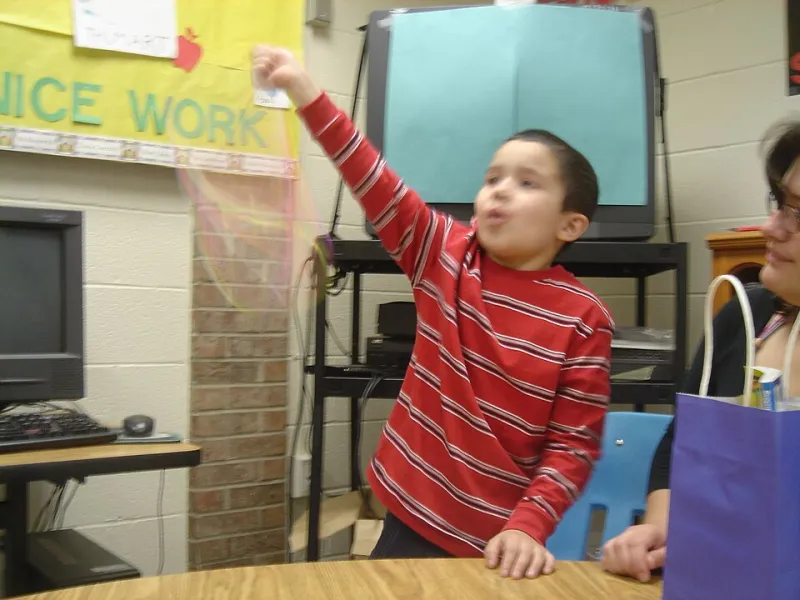
Photo: Pedro Vera from Reston, VA, USA, CC BY 2.0, via Wikimedia Commons
Picture this: It's 6 p.m. on a Tuesday. Dinner's almost ready, homework is half-done, and your child is sitting in the corner of the living room, flapping their hands and humming the same four notes on repeat. You've tried redirecting. You've tried distracting. Nothing seems to break through. By the time bedtime rolls around, you're exhausted — and so are they.
If this sounds familiar, you're not alone. Repetitive behaviors — what clinicians call "stereotypies" or "perseveration," and what many autistic people call stimming — are one of the most commonly misunderstood aspects of autism. They're also one of the most important things to understand before you try to change them.
Because here's the thing: these behaviors aren't happening to you. They're happening for your child.
What's Actually Happening in the Brain
The nervous system of an autistic child processes the world differently — often more intensely, with less automatic filtering of sensory input. Sounds, lights, social expectations, transitions, even hunger or fatigue can all pile up into an overwhelming cascade of signals that the brain struggles to organize.
Repetitive behaviors are one of the brain's most efficient self-regulation tools. When your child rocks, spins, or flaps, they're activating proprioceptive and vestibular pathways — the deep pressure and movement systems — that have a direct calming effect on the nervous system. Humming and vocalizing stimulate the vagus nerve, which plays a central role in shifting the body out of a stress response. Lining up objects or replaying the same video clip creates predictability in a world that often feels chaotic and uncontrollable.
In neurological terms, these behaviors help regulate sensory load, modulate arousal levels, and restore a sense of internal order. They're not signs of a broken brain. They're signs of a brain that's working overtime to keep itself together.
Why Stress Turns Up the Volume
You may have noticed that repetitive behaviors tend to increase at certain times — after school, during transitions, when routines are disrupted, or in the lead-up to something new. That's not a coincidence.
When cortisol and adrenaline spike — the hormones associated with stress — the nervous system's need for regulation increases dramatically. Think of it like a pressure valve. The more overwhelm builds, the more the system reaches for its most reliable release mechanism. For many autistic kids, that mechanism is stimming.
This is why trying to suppress these behaviors during high-stress moments often backfires. When a child is already in a dysregulated state and we remove their primary coping tool, the pressure doesn't disappear — it just has nowhere to go. What follows is often a meltdown, shutdown, or escalation that could have been avoided entirely.
Perseveration — getting stuck on a specific topic, phrase, or thought pattern — works similarly. When the brain is overwhelmed, it tends to retreat to familiar mental territory. It's the cognitive equivalent of rocking back and forth: a loop that feels safe and manageable when everything else feels like too much.
Reading the Pattern Before It Peaks
One of the most powerful things parents can do is learn to recognize the early signals — the moments when stimming starts to ramp up before a full overwhelm spiral takes hold.
For many kids, there's a predictable arc. Low-level stimming might look like hand-flapping while watching TV or humming quietly during a car ride — these are normal, healthy self-regulation behaviors. But as stress accumulates, the intensity often increases: the flapping becomes more frantic, the humming gets louder, the perseveration becomes harder to redirect.
Keeping a loose log for a week or two can be genuinely eye-opening. Note the time of day, what just happened (or was about to happen), what your child had eaten recently, how their sleep was the night before, and what the stimming looked like. Patterns tend to emerge pretty quickly — and once you can see them, you can start to intervene earlier, when the window for gentle support is still wide open.
Supporting the Nervous System Instead of Fighting It
The goal isn't to eliminate repetitive behaviors. The goal is to support the nervous system so those behaviors don't need to escalate to crisis levels.
Here are a few approaches that families have found genuinely helpful:
Sensory alternatives that meet the same need. If your child seeks deep pressure through repetitive rocking, a weighted blanket or compression vest during high-stress times can offer the same neurological input in a form that's easier to manage in different settings. If they seek vestibular input through spinning, a swing or balance board can provide that in a more intentional way. The key is matching the type of input, not just offering a distraction.
Co-regulation before self-regulation. Young children — and many older ones — can't regulate their nervous systems entirely on their own. Your calm presence is a genuine biological resource. Slow, steady breathing, a low and even tone of voice, and gentle physical proximity can actually help shift your child's nervous system through a process called co-regulation. You're essentially lending them your regulated state until they can find their own.
Honoring the behavior while expanding the window. Rather than interrupting stimming abruptly, try joining it briefly before gently offering an alternative. Sit beside your child and match their rhythm for a moment — then slowly introduce something new. This approach, rooted in the Son-Rise Program's philosophy of joining before leading, tends to reduce resistance and build connection in a way that abrupt redirection simply doesn't.
Nutrition and blood sugar stability. This one often gets overlooked, but it matters more than most parents expect. Blood sugar dips — common in kids who are picky eaters or skip meals — can significantly increase nervous system reactivity and lower the threshold for dysregulation. Offering a protein-rich snack in the mid-afternoon, before the after-school crash hits, can sometimes reduce the intensity of evening stimming in a way that surprises families.
Predictable transitions. Many autistic children stim more intensely around transitions because transitions require the brain to shift gears rapidly — something that's neurologically harder when sensory processing is already taxed. Giving a verbal or visual countdown before a change ("Five more minutes, then we're going to get in the car") gives the nervous system time to prepare, which often reduces the spike in repetitive behavior that transitions can trigger.
Changing the Story You Tell Yourself
There's an emotional component to all of this that's worth naming directly. When your child is stuck in a repetitive loop, it can feel like a wall going up between you. It can feel like failure, or fear, or grief. Those feelings are valid and they're common among parents in this community.
But when you understand that your child's spinning, rocking, or repeating is their nervous system's best attempt to cope with a world that often feels like too much — something shifts. The behavior stops looking like a problem to be solved and starts looking like a message to be heard.
And that shift? That's where real connection begins.
At Son-Rise Wellness, we believe that supporting autistic children means starting with understanding — their neurology, their sensory world, and the remarkable ways their brains work to keep them safe. The overwhelm spiral is real. But so is the path through it.
You don't have to figure it out alone.