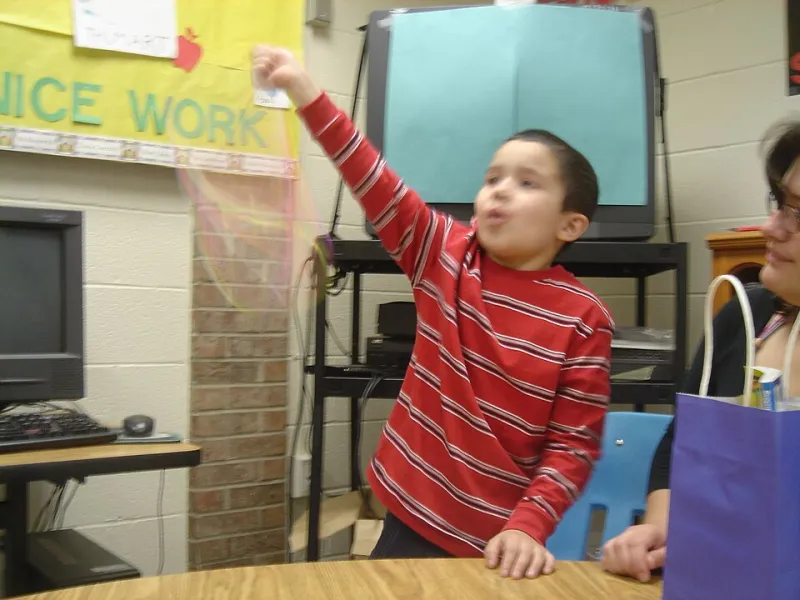
When 'No' Is the Healthiest Word Your Child Can Say
Photo: Malephi, Public domain, via Wikimedia Commons
Most of us were raised to believe that a child who says no is a child who needs redirecting. Push through the resistance. Stay consistent. Don't let them run the show. And honestly, that logic makes sense in a lot of parenting contexts — routines matter, safety matters, and kids genuinely do need guidance.
But for autistic children, the equation is more complicated. When your child digs their heels in, covers their ears, or melts down the moment you ask them to do something they didn't choose, something neurological is happening beneath the surface. And how you respond to that resistance may have more impact on their long-term regulation — and even their development — than the activity you were trying to get them to do in the first place.
Your Child's Nervous System Is Always Listening
Here's something worth sitting with: the autonomic nervous system doesn't distinguish between a tiger in the backyard and a well-meaning parent insisting on a hug. When a child perceives a threat to their sense of safety or control, the body responds accordingly. Heart rate climbs. Muscles tense. The thinking brain — the part that can learn, connect, and communicate — goes partially offline.
For autistic kids, who often experience the world with heightened sensory sensitivity and a nervous system that's already working overtime, this threat-detection system tends to be more finely tuned. It's not a character flaw. It's neurobiology. And when we repeatedly override a child's expressed discomfort — even in small ways, even with the gentlest intentions — we're essentially telling their nervous system that its signals don't matter.
Over time, that message accumulates. Kids who've learned that their 'no' won't be respected often stop bothering to say it. They either shut down completely or find other, louder ways to communicate the same thing. Neither outcome is what any parent wants.
The Compliance Trap
Traditional approaches to autism support have historically leaned heavily on compliance training — teaching kids to follow instructions, tolerate discomfort, and conform to social expectations. There's a reason this became the dominant model: it produces visible, measurable results, and in some contexts, it does help kids navigate the world more safely.
But there's a cost that often doesn't show up in session notes. When a child spends significant portions of their day suppressing their own instincts in order to meet external demands, they're burning through enormous amounts of regulatory energy. Think of it like running a car engine at high RPMs all day long. The car moves, but the wear and tear is real — and eventually, something gives.
For many families, this looks like a child who seems fine during structured activities but completely falls apart the moment they get home. The school held it together. The therapy session held it together. And then you asked them to put their shoes away and the whole day collapsed.
That collapse isn't defiance. It's a nervous system that's been holding on for hours finally letting go.
What Autonomy Actually Does for the Brain
Research on psychological safety and stress regulation consistently points to one of the most powerful nervous system regulators available to humans: the sense of control. When we feel like we have agency — when our choices matter and our limits are respected — our stress response quiets down. We feel safer. And when we feel safer, we're more available for connection, learning, and growth.
For autistic children, this isn't just a nice-to-have. It's foundational. A child who trusts that their 'no' will be honored is a child whose nervous system can afford to stay regulated. And a regulated nervous system is one that can take in new information, tolerate transitions, and engage with the world more flexibly.
In other words, honoring your child's refusal isn't the opposite of helping them grow. In many cases, it's the precondition for it.
Practical Ways to Build a 'Yes to No' Environment
None of this means your household becomes a free-for-all where your child opts out of everything indefinitely. Family life has real requirements — safety, school, mealtimes, hygiene. The goal isn't to eliminate expectations. It's to build enough relational safety that your child's nervous system isn't in constant defense mode.
Here are some starting points:
Offer genuine choices whenever possible. Instead of "Time to get dressed," try "Do you want to start with your shirt or your pants?" Small choices build the experience of agency without undermining necessary structure. Over time, that experience becomes a kind of internal scaffolding.
Distinguish between non-negotiables and preferences. Be honest with yourself about which battles actually matter. Buckling a seatbelt is non-negotiable. The exact sequence of the morning routine probably isn't. When kids experience more flexibility in lower-stakes situations, they tend to handle the firm limits better.
Narrate the respect. When your child says no to something and you honor it, say so out loud. "You told me you didn't want to go to the store today, so we're staying home." This builds explicit awareness that their voice has power — which is exactly what a dysregulated nervous system needs to start settling.
Create a low-pressure way to say 'too much.' Some kids don't have the words in the moment. Work together on a signal — a card, a gesture, a single word — that means "I'm overwhelmed and need out." When that signal is consistently respected, kids use it more readily and escalate less.
Repair after the hard moments. There will be times you push through the no because you have to. That's real life. What matters is what comes after. A simple "That was hard for you and I kept going anyway. I'm sorry it felt like that" does more for the relationship — and the nervous system — than you might expect.
Reframing the Goal
When we shift from "how do I get my child to comply" to "how do I help my child feel safe enough to engage," something quietly shifts in the whole dynamic. Parents often report that when they start genuinely honoring their child's limits, the child actually becomes more cooperative over time — not less. Because the nervous system isn't spending all its energy on defense anymore.
Your child's 'no' is information. It's communication. It's their nervous system doing exactly what it's designed to do. The question isn't how to override it — it's how to listen to it in a way that builds trust, safety, and eventually, more flexibility.
At Son-Rise Wellness, we believe that real progress grows from the inside out. And sometimes, the most powerful thing a child can do for their own development is feel genuinely free to say no.